In contemporary industrial manufacturing, pneumatic automation represents one of the most versatile, high-speed, and economical power transmission media. From automated packaging machinery and high-speed robotic pick-and-place systems to heavy automotive assembly jigs, compressed air drives countless production processes. However, because air is invisible, clean, and ubiquitous, shop-floor operators and maintenance personnel frequently underestimate the tremendous kinetic and potential energy compressed within pneumatic circuits. When operating at typical plant pressures of 6 to 10 bar (87 to 145 psi), pneumatic systems present acute occupational hazards: violent hose whipping, air embolism, unexpected mechanical clamping, and catastrophic structural ruptures. Strict adherence to occupational health and safety (OHS) standards and ISO 4414 is not merely a regulatory mandate; it is the fundamental baseline for protecting human life and preserving manufacturing continuity.
What Are the Primary Physical Hazards of Industrial Compressed Air?
Developing an effective plant safety protocol begins with an uncompromising thermodynamic and mechanical risk assessment. Compressed air stores immense potential energy due to its compressibility. When a line ruptures or is improperly opened, this potential energy converts instantly into destructive kinetic energy, expanding at supersonic velocities:
- Air Embolism (Fatal Direct Injection): When compressed air at pressures as low as 1.5 to 2.0 bar contacts human skin directly—even through multiple layers of clothing—it can penetrate the epidermis, entering capillary blood vessels. Air bubbles entering the arterial bloodstream form an air embolism. If these bubbles travel to coronary arteries or cerebral vessels, they induce catastrophic stroke, myocardial infarction, or immediate death. Using compressed air blowguns to clean clothing, skin, or hair is strictly prohibited by OSHA and international labor laws.
- High-Velocity Foreign Body Eye Injuries: High-speed compressed air streams entrain metallic shavings, rust flakes, abrasive dust, and droplet mists. When directed carelessly, these particles act as sandblasting media, causing irreversible corneal abrasion, eye lacerations, or permanent blindness.
- Tympanic Membrane Rupture & Chronic Hearing Loss: An un-muffled compressed air line discharging to atmosphere generates acoustic noise exceeding 105 to 115 dB(A). Direct exposure within close proximity causes immediate acoustic trauma or permanent hearing loss, violating OSHA 1910.95 and EU Directive 2003/10/EC exposure limits.
Mandatory Statutory Prohibition: OSHA 29 CFR 1910.242(b)
Compressed air used for manual cleaning operations must be regulated strictly below 30 psi (2.1 bar) at the nozzle, and blowguns must feature safety chip-shielding vents that bypass flow if the nozzle tip becomes dead-ended against skin. Under no circumstance may direct-line factory pressure (6–8 bar) be utilized for manual blow-off without engineered safety nozzles.
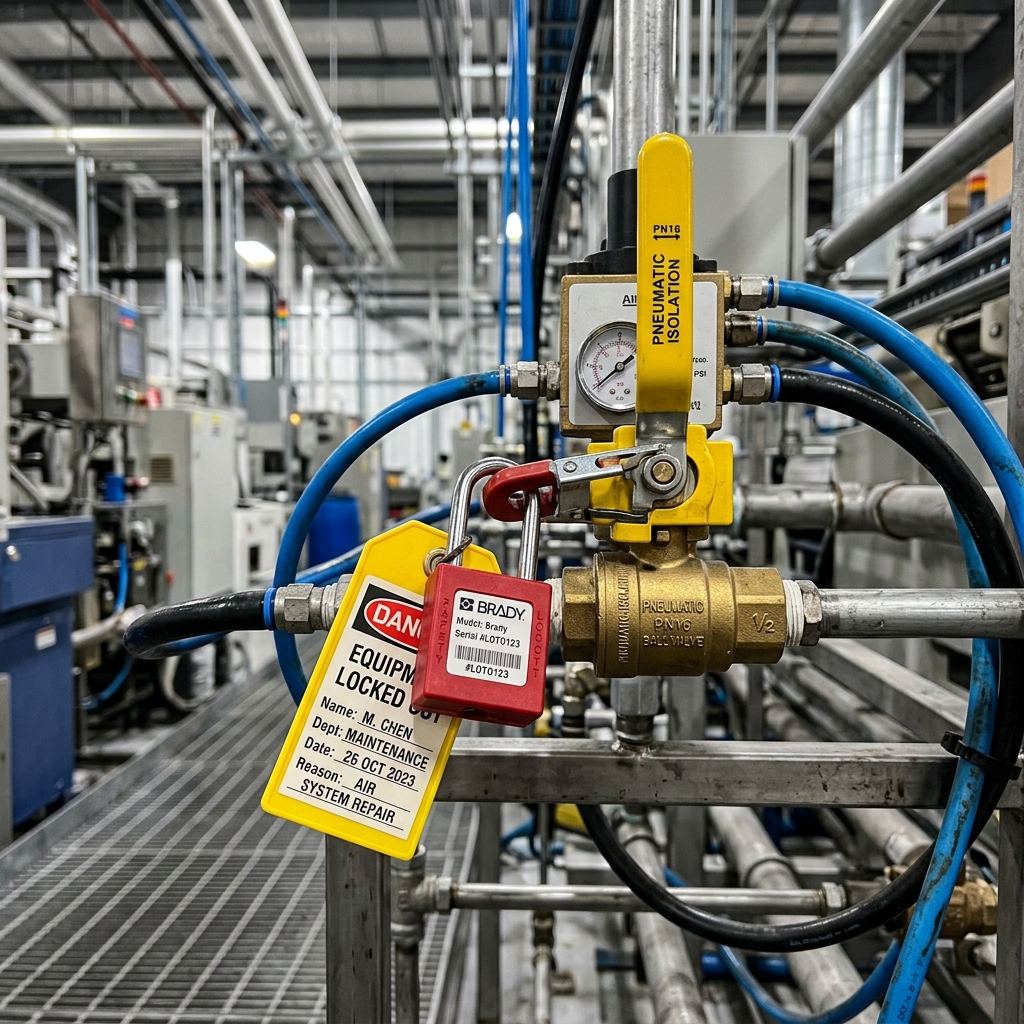
Figure 1: Standardized LOTO (Lockout/Tagout) isolation station equipped with padlock, lockout hasp, and exhausted residual pressure lockable valve.
How Does Hose Whipping Occur and How Can It Be Prevented?
Among the most violent and traumatic shop-floor accidents in pneumatic environments is hose whip. When a flexible rubber or polyurethane hose ruptures under pressure, or when a quick-disconnect coupling separates while pressurized, the unrestricted exhaust of high-velocity air generates a jet propulsion effect. The uncontrolled hose flails violently through the air at speeds exceeding 100 km/h, acting as a weighted steel-reinforced whip. Direct impacts cause fractured bones, facial crushing, and severe concussions to nearby workers.
Engineering defenses against hose whip include three mandatory safety mechanisms:
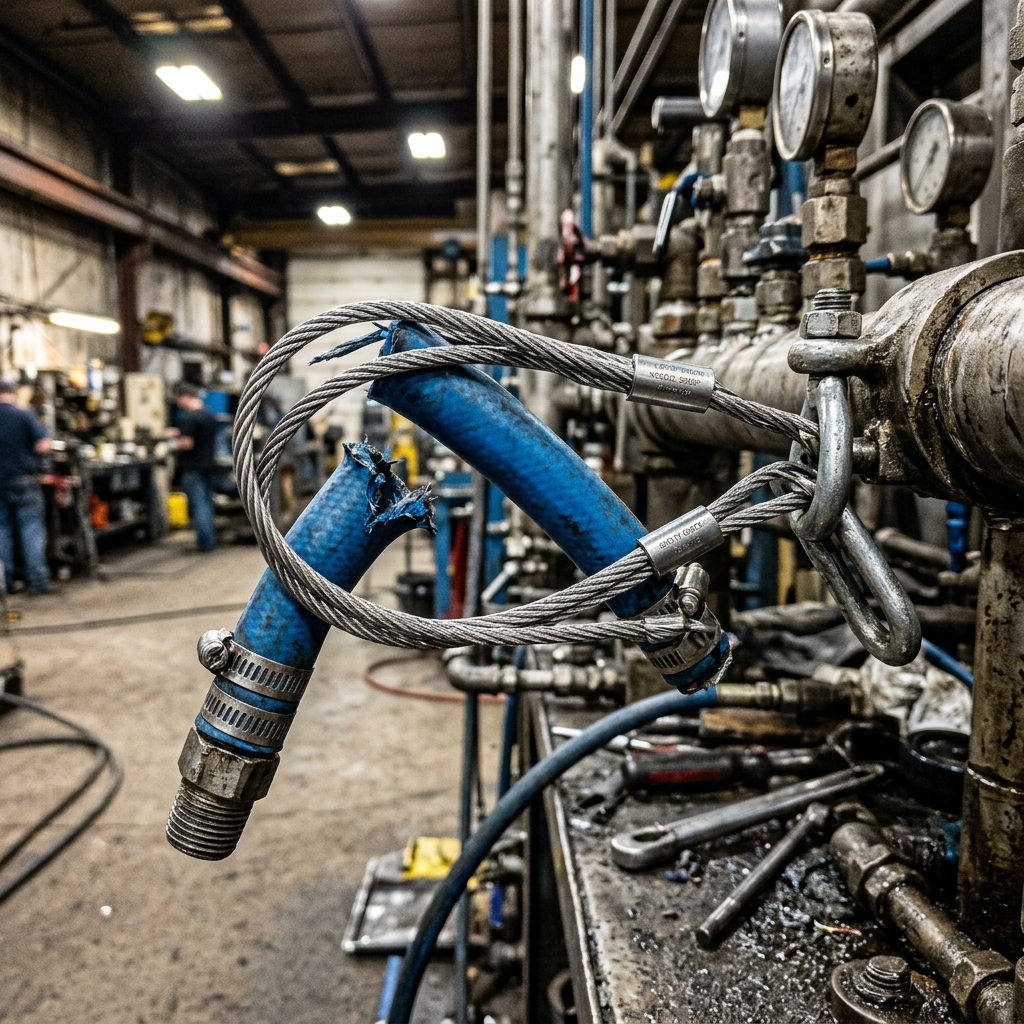
- Whip Check Safety Cables (ISO 4414 & OSHA 1926.302): Corrosion-resistant braided steel wire cables with spring-loaded loops clamped across every hose-to-hose and hose-to-tool connection. If the mechanical fitting decouples, the whip check cable arrests the hose travel, tethering it securely and preventing whipping.
- Hose Air Fuses (Velocity Excess-Flow Shutoff Valves): Autonomous in-line safety valves mounted directly at the supply manifold. If a downstream hose sever occurs, the sudden surge in volumetric flow creates an instantaneous differential pressure that trips the internal valve piston, shutting off line air within milliseconds.
- Two-Stage Vented Safety Quick-Connect Couplings (ISO 6150 / ISO 4414): Couplings designed to depressurize downstream hose volume before permitting mechanical disconnection. A primary push on the sleeve vents the trapped downstream air to an integrated silencer; only a second distinct push releases the mechanical plug, entirely eliminating disconnection projectile hazards.
Figure 2: Steel braided whip check restraint installed across pneumatic quick couplings to neutralize kinetic whip hazards.
Managing Stored Energy & Unintended Mechanical Actuator Motion
A catastrophic misconception among maintenance technicians is assuming that shutting off the electrical power to a machine renders its pneumatic actuators inert. Unlike electric motors that lose torque instantly upon power interruption, pneumatic cylinders retain compressed air trapped behind closed valve spools. A single-rod pneumatic cylinder holding 6 bar of air behind a 100 mm piston maintains over 4,700 Newtons (480 kg) of clamping force.
If an operator enters a machine envelope to clear a jammed workpiece or adjust tooling, and manually shifts a valve spool or uncouples a fitting, the trapped air will discharge violently, causing the cylinder to extend or retract instantly, crushing limbs caught within the kinematic mechanism.
To eliminate trapped energy risks, safety architectures require:
- Exhausting Lockout Dump Valves: 3/2-way lockable manual shutoff valves that isolate supply air while automatically dumping all downstream circuit air to atmosphere through high-flow silencers.
- Mechanical Rod Clamping Units (Brakes): On vertical cylinders lifting heavy tooling (such as press rams or packaging seal jaws), air pressure loss can allow the load to drop under gravity. Spring-applied, pneumatically released rod locking units mechanically grip the piston rod, holding heavy vertical loads securely even in total pressure loss scenarios.
- Pilot-Operated Check Valves with Manual Test Ports: Integrated locking valves on cylinder ports must incorporate accessible manual depressurization test buttons so technicians can physically verify zero pressure before loosening fittings.
The 7-Step Pneumatic Lockout / Tagout (LOTO) Zero-Energy Protocol
Over 80% of severe industrial pneumatic injuries occur during routine maintenance, cleaning, jam clearing, and setup operations. Implementing a rigorous Lockout / Tagout (LOTO) protocol per OSHA 29 CFR 1910.147 is the primary defense against unexpected re-energization:
| Step # |
Protocol Phase |
Operational Procedure |
Verification Standard |
| 01 |
Preparation & Notification |
Notify all affected machine operators, line supervisors, and adjacent personnel that the equipment is being taken offline for maintenance. |
Sign-off on Shift Work Permit |
| 02 |
Standard Shutdown |
Execute standard machine stop cycle through the main HMI or PLC control console to bring actuators to their rest park position. |
Verify HMI Stop Status |
| 03 |
Pneumatic Energy Isolation |
Rotate the main 3/2-way supply ball valve to the OFF position, cutting off the main plant air header feed. |
Valve Handle Detent in Closed Position |
| 04 |
Residual Pressure Exhaust |
Actuate manual exhaust relief ports, bleed air receiver tanks, and depressurize FRL filter bowls until line pressure reaches 0 bar. |
Manometer reads exactly 0 bar (0 psi) |
| 05 |
Physical Lockout Attachment |
Place an approved safety lockout padlock through the valve handle hasp. Each working technician must apply their own personal padlock. |
OSHA 1910.147 One Person / One Lock |
| 06 |
Prominent Warning Tagout |
Affix a weather-resistant warning tag displaying technician name, department, contact number, date, and maintenance purpose. |
Legible Industrial Warning Tag |
| 07 |
Zero-Energy State Verification |
Attempt to cycle actuators manually, check pressure gauges, and test cycle buttons to prove that the system is 100% mechanically dead. |
Physical Zero Energy Confirmation |
"A pneumatic machine that has been shut off is not necessarily safe. Compressed air trapped within cylinders and manifolds is an invisible loaded spring. Until that stored energy is physically vented, locked out, and verified at 0 bar, human hands must never enter the mechanical operating zone."
— BRS PROSES Industrial Safety & Automation Directorate
Functional Safety Standards: ISO 13849-1 & Monitored Safety Dump Valves
In modern automated cells, emergency stops (E-Stops) and optical safety light curtains must de-energize the pneumatic system safely without relying on standard commercial directional valves. Standard solenoid valves are subject to spring fatigue, coil burnout, and particulate contamination that can cause spools to stick in the actuated position.
To conform to ISO 13849-1 Performance Level d or e (PL d/e, Category 3 or 4), machinery must incorporate redundant safety dump valves:
- Dual Redundant Spools in Series/Parallel: Two independent valve elements operate in tandem. If one valve spool mechanically jams or experiences an electrical failure, the redundant secondary spool safely exhausts system air.
- Integrated Dynamic Position Sensors: Inductive proximity sensors monitor the physical position of each valve spool. If the safety relay detects an asynchronous state between the two spools, it locks out further operation until repaired.
- Controlled Soft-Start Functionality: When re-energizing after an emergency stop, instantaneous air pressure surges can cause unguided cylinders to lurch violently, damaging tooling or injuring setup personnel. Integrated soft-start modules introduce air slowly through an adjustable needle valve until downstream pressure reaches 50%–60% of line pressure, at which point the main valve opens fully for smooth, controlled motion.
Personal Protective Equipment (PPE) & Environmental Workstation Controls
While engineering controls (LOTO, safety valves, whip checks) form the primary hierarchy of defense, mandatory Personal Protective Equipment (PPE) must be enforced across all pneumatic operating zones:
- High-Impact Safety Eyewear (ANSI Z87.1 / EN 166): Must feature wrap-around side shields to block deflected high-velocity debris. In grinding or metal fabrication zones, full-face polycarbonate shields are mandatory over safety glasses.
- Hearing Protection: Earmuffs or custom-molded silicone earplugs with a Noise Reduction Rating (NRR ≥ 25 dB) must be worn in compressor rooms and near un-silenced exhaust banks.
- Mechanical Barrier Gloves: Abrasion-resistant gloves protecting against sharp burrs, pinch points, and cold air burns during high-flow depressurization.
- Steel-Toe Puncture-Resistant Footwear: Certified to ASTM F2413 or EN ISO 20345 to protect against dropped tooling, heavy pneumatic cylinders, and metal manifold blocks.
Conclusion: Cultivating a Zero-Accident Culture with BRS PROSES
Industrial safety in pneumatic systems is not achieved through slogans or passive warning labels; it is forged through rigorous engineering design, standard-compliant hardware selection (ISO 4414, ISO 13849), and uncompromising shop-floor discipline. By eliminating hose whip risks, deploying redundant monitored dump valves, and enforcing foolproof LOTO protocols, manufacturing facilities transform pneumatic automation into a safe, reliable, and accident-free production medium.
BRS PROSES provides comprehensive pneumatic safety audits, machine risk assessments, CE-compliant safety valve integration, and turnkey LOTO retrofits for industrial facilities across Turkey and international markets. Contact our technical team to ensure your pneumatic installations meet the highest standards of modern industrial safety.