Although the hydraulic system powering a 50-ton quarry excavator and the hydraulic power unit actuating an automotive sheet stamping press both operate on the fundamental physical tenets of Pascal's Principle ($P = F / A$), they represent two radically divergent philosophies of engineering design. In fluid power engineering, whether an application is categorized as mobile (transportable machinery subject to dynamic travel loads) or stationary industrial (fixed factory installations anchored to concrete foundations) fundamentally dictates material selection, component topology, thermal management, filtration strategy, and electro-hydraulic control architecture.
1. Weight, Envelope & Power Density Optimization (kW/kg & kW/dm³)
The primary conceptual constraint governing mobile hydraulic engineering is the relentless imperative to minimize gross machine weight and component volume. In earthmoving excavators, agricultural tractors, forestry harvesters, and mobile telescopic cranes, every unnecessary kilogram of dead weight diminishes machine payload capacity, elevates chassis center-of-gravity, and increases diesel fuel or battery electrical consumption. Consequently, mobile fluid power prioritizes the maximization of gravimetric and volumetric power density above all other design variables.
This severe envelope restriction shapes component metallurgy:
- Mobile Compact Metallurgies: Valve blocks, pump casings, and directional control sections utilize high-yield ductile cast irons (compacted graphite iron - CGI) or high-strength extruded aerospace aluminum alloys. Pumping units gravitate toward bent-axis or swashplate axial piston pumps capable of delivering transient peak pressures of 380 to 450 bar from physical packages weighing under 50 kg. Integrated multi-function monoblock valves and screw-in cartridge valves (SiCV) eliminate external subplates and bulky interconnecting steel tubing.
- Miniaturized Reservoir Capacities: Mobile oil reservoirs are restricted by vehicle chassis envelopes, typically holding fluid volumes merely 0.8 to 1.5 times the pump's maximum flow rate per minute ($V_{tank} \approx 1.0 \times Q_{pump}$). In a 200 L/min mobile excavator, the reservoir may hold only 180 to 250 liters of oil. With fluid recirculating through the circuit every 45 to 60 seconds, internal tank baffles and multi-layer return diffusers must be engineered using Computer Fluid Dynamics (CFD) to ensure rapid de-aeration without permitting air bubble re-ingestion.
Conversely, in stationary industrial installations (forging presses, plastic injection molding machines, continuous steel casting lines, and hydroelectric dam gates), structural mass and physical footprint are minor constraints. Industrial power units prioritize unlimited 24/7 operating fatigue life, maximum mechanical damping, ease of maintenance, and passive thermal dissipation.
Industrial power units utilize massive nodular cast iron housings (GGG40/50) and manifold blocks precision-machined from solid forged carbon steel blocks. Pumping assemblies favor low-noise, heavy-duty radial piston pumps or internal gear pumps anchored to heavy structural steel baseplates via vibration-damping elastomer rails. Industrial reservoirs are generously sized, holding 3 to 5 times (and up to 10 times in critical servo circuits) the pump's flow rate per minute ($V_{tank} \approx 3\text{--}5 \times Q_{pump}$). A 500 L/min industrial stamping press unit commonly integrates a 2500-liter reservoir, allowing oil residence times of 5 to 6 minutes. This immense fluid volume allows contaminants to settle into magnetic drain sumps, allows microscopic entrained air to escape naturally, and stabilizes fluid bulk temperature.
"In fluid power system engineering, the trade-off between aggressive power density optimization and passive thermodynamic/mechanical stability represents the defining paradigm separating mobile from stationary industrial machinery."
— BRS PROSES Systems Engineering Directorate
2. Operating Environment: Dynamic Multi-Axis Shock vs. Stationary Plant Stability
Mobile machinery operates under brutal, unconditioned environmental extremes. A forestry harvester in Northern Sweden must cold-crank at −35°C ambient temperature, yet reach fluid temperatures of +90°C during continuous harvesting operations. This 125°C thermal delta requires micro-engineered diametral clearances across valve spools and cylinder bores; otherwise, differential thermal expansion coefficients between steel spools and aluminum bodies will cause catastrophic spool seizure during cold starts, or massive internal bypass leakage at operating temperatures.
Furthermore, mobile machinery is subjected to severe, multi-axis dynamic mechanical shock and vibration:
- Mechanical Shock & Structural Flexure: Excavator bucket impact against solid granite, rough terrain transit, and sudden boom deceleration impose accelerations of 5g to 15g across hydraulic lines. High-frequency vibration induces metal fatigue at rigid tube welds and plastic deformation of threaded connectors.
- External Environmental Contaminants: Airborne silica dust (<5 µm), mud, salt spray in marine cargo handling, and high-pressure steam power-washing constantly threaten rod seals and reservoir breathers.
By contrast, stationary industrial systems inhabit climate-controlled plant environments maintained at +15°C to +30°C. Machines are anchored to reinforced concrete foundations via seismic grout and heavy anchor bolts, isolating the hydraulic circuit from external terrain disturbances. Internal hydraulic shocks—such as decompression shock during press breakthrough—are strictly managed via nitrogen-charged hydraulic accumulators, soft-switching proportional spool ramping, and pre-decompression poppet valves.
| Technical Parameter |
Mobile Hydraulics Architecture |
Stationary Industrial Hydraulics |
Primary Governing Standard |
| Operating Pressure Envelope |
350–420 bar nominal; 450 bar peaks |
160–250 bar (general); 315 bar (heavy press) |
ISO 6020-2 / ISO 6022 |
| Reservoir Sizing Ratio ($V_{tank} / Q_{pump}$) |
0.8–1.5x pump volumetric flow/min |
3.0–5.0x (up to 10x for servo systems) |
DIN 24339 |
| Hydraulic Fluid Specification |
High VI (≥150) Multi-grade HVLP / synthetic |
Monograde HLP (ISO VG 32/46/68); water-glycol (HFC) |
DIN 51524 Part 2 & 3 |
| Piping & Fitting Technology |
ORFS (ISO 8434-3), JIC 37°, SAE Code 61/62 split flanges |
DIN 2353 bite-type, CETOP manifold blocks, seamless tube |
ISO 8434-1 / DIN 2391 |
| Contamination Control Target |
ISO 4406: 20/18/15 (Return & high-pressure filtration) |
ISO 4406: 15/13/10 (Continuous kidney-loop β≥1000) |
ISO 4406 / ISO 16889 |
| Electronic Control Architecture |
CAN bus (SAE J1939 / CANopen), ruggedized IP67 ECUs |
EtherCAT, PROFINET, IO-Link, cabinet PLCs, servo amplifiers |
IEC 61131 / ISO 13849 |
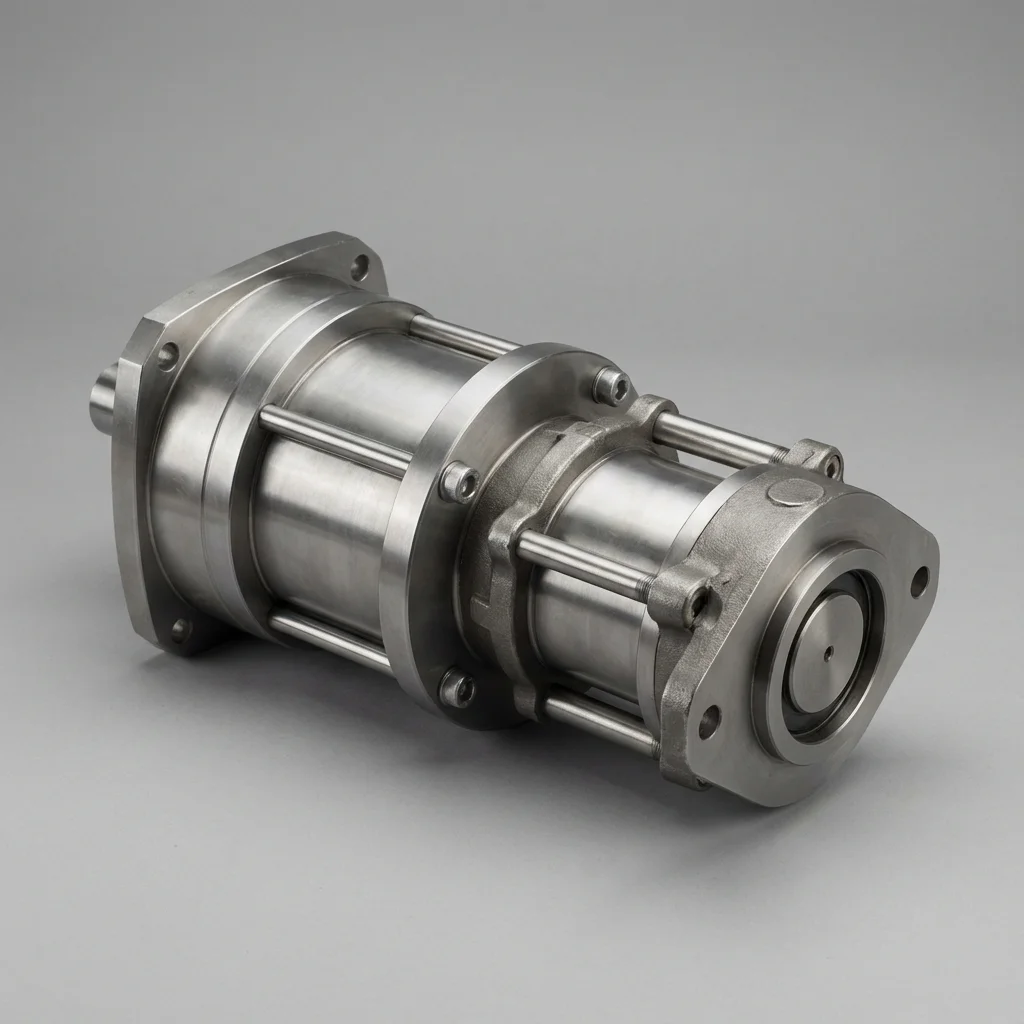
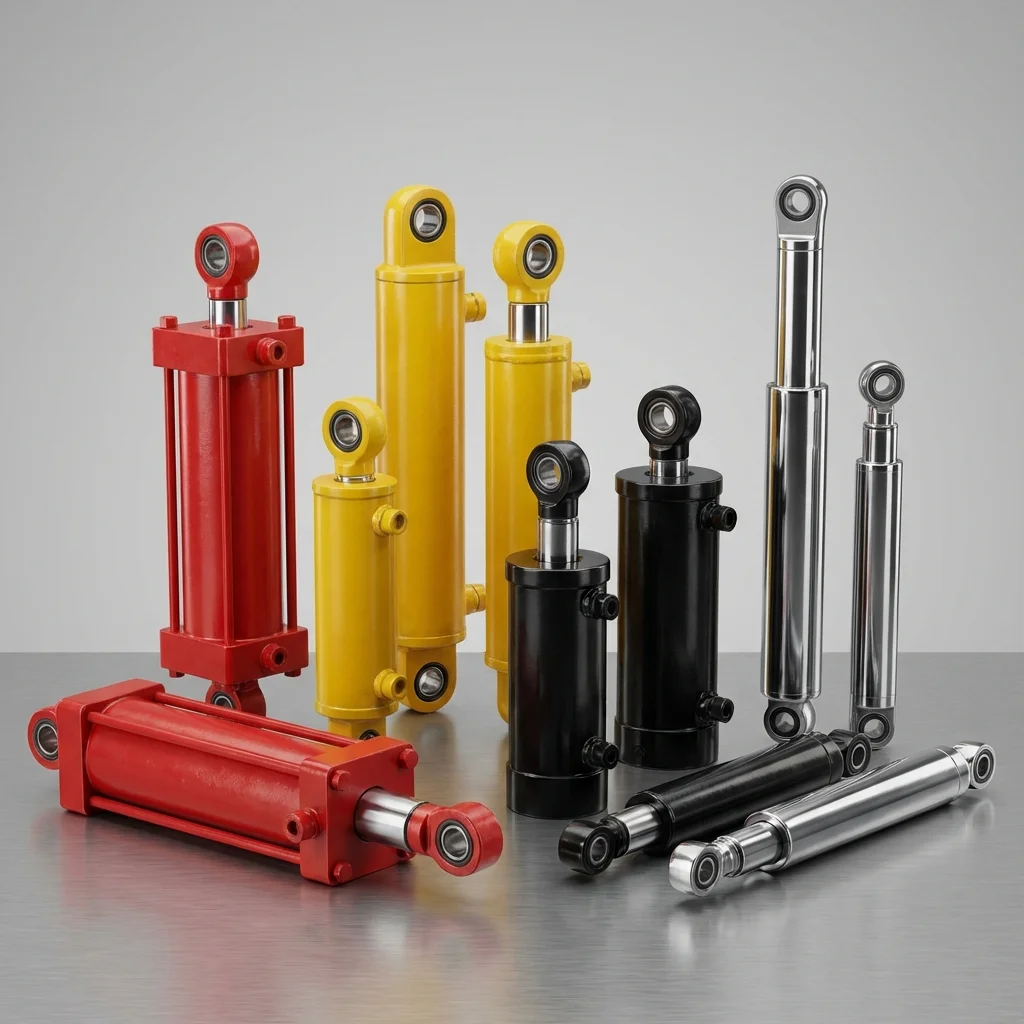
Industrial cylinder design: Rigid tie-rod construction with low-friction PTFE seals.
Mobile fluid power: High-pressure swashplate pump engineered for maximum power density.
3. Fluid Tribology: Viscosity Index, Shear Stability & Bulk Modulus
Hydraulic fluid is not merely a power transmission medium; it is a structural mechanical element of the machine. The radical differences in thermal management between mobile and stationary systems necessitate distinct fluid formulations:
- Mobile Multi-Grade HVLP Fluids: To cope with wide ambient temperature swings, mobile machinery utilizes high viscosity index oils (VI ≥ 150) fortified with long-chain polymer VI improvers. These polymer chains expand at elevated temperatures to prevent oil thinning, and coil at cold temperatures to maintain pump intake flowability. However, under the extreme shear stresses encountered in high-pressure relief valves, polymer chains undergo permanent mechanical shearing (shear thinning), necessitating strict oil analysis intervals.
- Industrial Monograde HLP Fluids: Stationary systems utilize thermostatic heat exchangers to maintain bulk oil temperature within a narrow 45°C to 55°C window. Because temperature is tightly stabilized, industrial circuits utilize shear-stable monograde HLP oils (DIN 51524-2) free of polymer additives. These fluids exhibit virtually zero shear degradation, retaining lubricating film strength over tens of thousands of operating hours.
- Effective Bulk Modulus (β): In high-speed industrial servo-presses, fluid compressibility directly dictates positional tracking accuracy. Air-free mineral oil exhibits a theoretical bulk modulus of ~15,000 bar. Industrial reservoirs allow complete fluid de-aeration, preserving high bulk modulus. In mobile systems, small, churning reservoirs retain 1% to 3% entrained air, degrading effective bulk modulus and causing hydraulic "sponginess" that mobile motion controllers must actively compensate for via predictive control algorithms.
4. Piping Connections, Port Geometry & Dynamic Sealing Technologies
Under severe dynamic vibration and frame deflection, traditional threaded pipe fittings with tapered threads (NPT/BSPT) or flat bonded copper seals loosen, frett, and leak. In mobile hydraulics, zero-leakage standards demand mechanical captive sealing:
- O-Ring Face Seal (ORFS - ISO 8434-3): Featuring a precision machined face groove containing an elastomeric O-ring that seals against a flat flanged sleeve, ORFS fittings absorb substantial chassis flex and vibration without backing off or galling threads.
- SAE 4-Bolt Split Flanges (J518 / ISO 6162): Standard for pump outlets and main distribution lines. Code 61 (3000 psi) and Code 62 (6000 psi) split flanges distribute clamping torque across four high-tensile bolts, eliminating pipe wall stress concentrations.
- Mobile Cylinder Sealing: Piston rods are induction case-hardened to 55–60 HRC with 30–50 µm hard chrome plating to resist stone chips and abrasive gravel. Seal configurations utilize heavy-duty metal-canned polyurethane (PU) double-lip wiper seals that aggressively shave frozen mud and foreign particles from the retracting rod.
In stationary industrial systems, pipe runs are predominantly constructed from rigid, thick-walled seamless precision cold-drawn steel tubes (DIN 2391 / EN 10305-4) anchored via DIN 3015 vibration-absorbing clamps. Fittings rely on DIN 2353 24-degree bite-type ferrule couplings or direct flanged integration onto multi-station CETOP/ISO manifold blocks (ISO 4401 sizes D03, D05, D07, D08). Industrial cylinder rod seals prioritize ultra-low dynamic friction and stick-slip suppression over external scraping capacity, deploying bronze-filled PTFE step-seals and hydrostatic fluid bearings for sub-millimeter positional control.
5. Electronic Control Topologies: Mobile Load-Sensing vs. Industrial Closed-Loop Servo
The electronic command architecture in mobile equipment is driven by operator ergonomics, energy conservation, and ruggedized packaging:
- Mobile Load-Sensing (LS) & Flow Sharing (LUDV): Variable swashplate pumps adjust displacement dynamically to match the highest instantaneous load pressure demanded by multiple simultaneously operating actuators. Electronic controllers (ECUs) are sealed to IP67/IP69K, withstand −40°C to +85°C operating ambients, and communicate over ruggedized SAE J1939 CAN bus networks. Proportional valve actuation is predominantly electro-proportional pilot operated or PWM-driven.
- Industrial Electro-Hydraulic Servo Systems: Industrial controllers execute microsecond-synchronized motion profiles across high-bandwidth fieldbuses (EtherCAT with distributed clocks < 1 µs jitter, PROFINET IRT). Direct-drive servo-solenoid valves with integrated LVDT spool feedback and frequency responses exceeding 100 Hz regulate multi-axis position, velocity, and pressing force with repeatability under ±0.01 mm.
Conclusion: Engineering Precision for Every Operating Realm
Whether engineering an ultra-compact, high-pressure mobile power unit capable of withstanding rough quarry terrain, or designing an industrial servo-hydraulic manifold that must cycle millions of times with sub-millimeter precision, understanding the profound technical divergence between mobile and industrial fluid power is the cornerstone of engineering success.
At BRS PROSES, our engineering team designs, manufactures, and commissions custom fluid power solutions tailored to the exact thermodynamic, mechanical, and regulatory demands of each operating environment, delivering uncompromising reliability from factory floor to heavy field machinery.