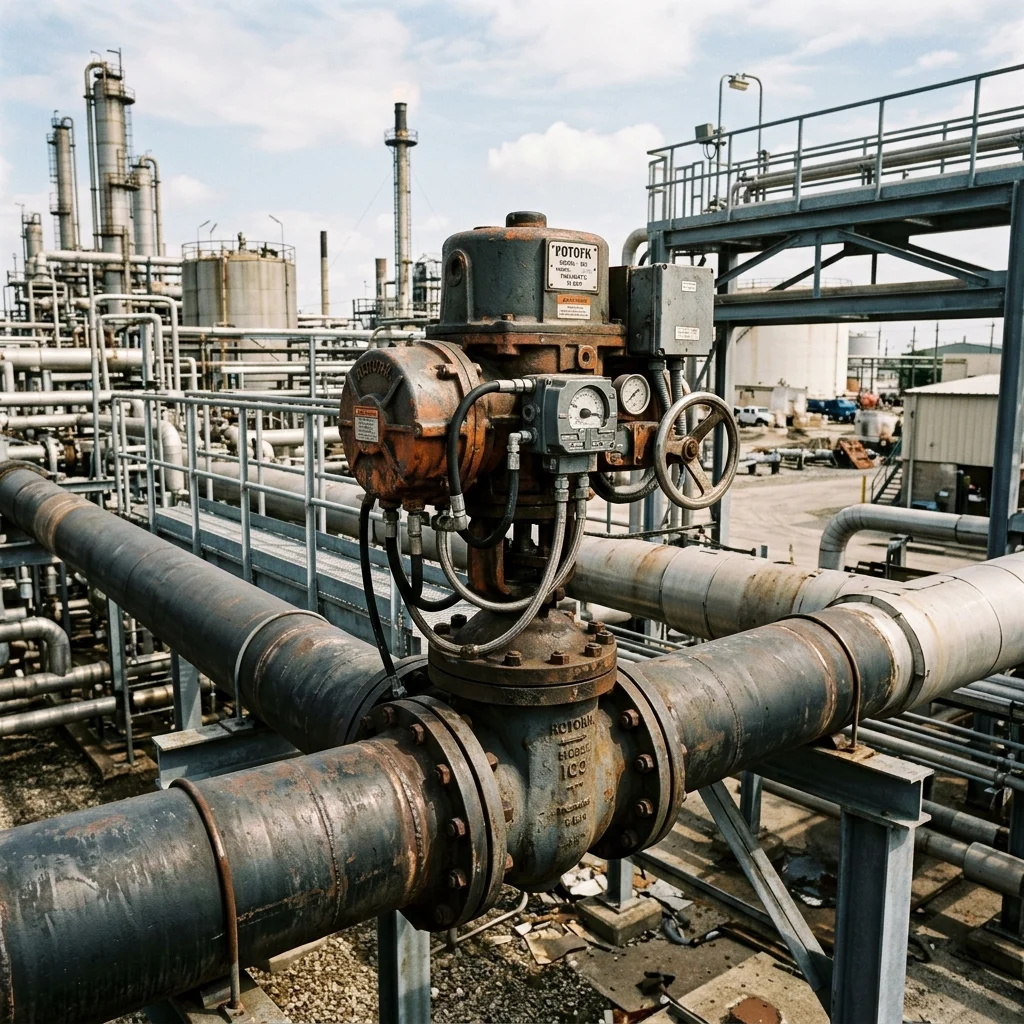
Chemical plants, coastal facilities, and mining sites put an actuator through a very different life than a standard factory floor. If acid vapor, saltwater, or temperatures near 150°C are in play, the "standard" catalog model fails within months. What matters here isn't motor power - it's body and seal material.
Quick Decision Table
Classify the environment first by temperature range, then by chemical exposure; material selection follows these two axes.
1. Choosing the Body Material
316L stainless steel has become the default choice for industrial actuators and is sufficient for most harsh environments. Its molybdenum content makes it noticeably more resistant to pitting corrosion than 304 grade, and it also welds and machines well.
1.1. Where 316L Falls Short
On a coastal platform or a process line with high chloride concentration, even 316L can eventually suffer pitting corrosion. In such cases, duplex stainless steel (like 2205) or nickel-based special alloys are preferred; cost rises 30-40%, but service life extends several times over.
1.2. Balancing Cost With Coating
If the environment is only moderately humid outdoors, an epoxy powder-coated aluminum body is also a reasonable solution. Aluminum is light and cheap upfront, but protection disappears the moment the coating is scratched.
| Material | Temperature Range | Chemical Resistance | Typical Cost Index |
|---|
| NBR seal | -30°C / +100°C | Medium (hydraulic oil) | 1x |
| Viton (FKM) | -20°C / +200°C | High (acid, solvent) | 3-4x |
| PTFE | -200°C / +260°C | Nearly universal | 5-6x |
| 316L stainless | Structural, not temp-limited | Good (moderate chloride) | 1.3x (vs 304) |
2. Seal Material Compatibility
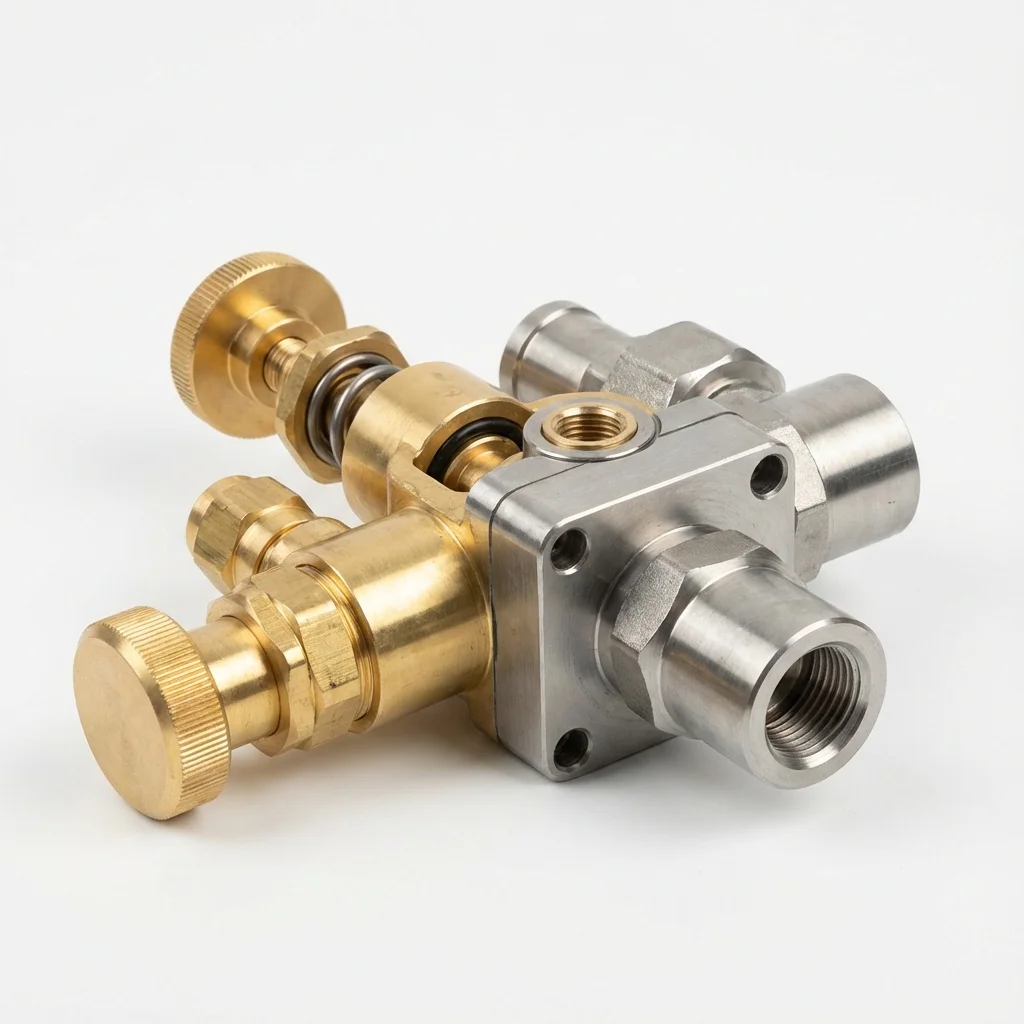
Even with the right body, the wrong internal seal still causes failure. Temperature and chemical exposure constrain elastomer choice far more tightly than they constrain the body.
- NBR: works well from -30°C to 100°C, fails against acid vapor or heat above 120°C
- Viton (FKM): handles up to 200°C and resists a wide chemical range
- PTFE: nearly inert to chemicals, but needs support elements due to low flexibility
"Material selection isn't a catalog decision, it's an environment-analysis decision. Misjudge the temperature range or chemical exposure and even the most expensive body is useless."
— BRS PROSES Engineering Team
3. Field Examples
A pneumatic actuator exposed to ammonia vapor at a fertilizer plant failed twice in six months with a standard NBR seal; after switching to Viton, it has run trouble-free for two years. On a ship deck exposed directly to saltwater, a 316L body proved sufficient for a hydraulic cylinder, but the piston rod's chrome plating had to be thicker than standard.
4. BRS Proses Material Selection Support
BRS PROSES engineering assesses your environmental conditions and determines the body/seal combination together:
- Free environment analysis and material recommendation
- 316L, duplex, and special alloy body options
- NBR, Viton, and PTFE seal combinations
- Material revision based on field failure history
6. Metallurgy in Chemically Aggressive Environments: 316L, Duplex & Titanium
In harsh industrial settings (offshore oil platforms, chemical fertilizer plants, subsea actuators), carbon steel cylinders coated with standard paint degrade rapidly. BRS PROSES specifies advanced corrosion-resistant metallurgical alloys:
- Austenitic Stainless Steel (AISI 316L / 1.4404): Molybdenum addition (2–3% Mo) provides high pitting resistance in food washdown, marine atmospheres, and mild acid environments ($PREN approx 23–25$).
- Duplex Stainless Steel (2205 / 1.4462): Combines austenitic and ferritic microstructures, doubling mechanical yield strength ($ge 450 ext{MPa}$) while offering superior chloride stress corrosion cracking resistance ($PREN ge 35$).
- Titanium Grade 5 (Ti-6Al-4V): Maximum strength-to-weight ratio with near-infinite corrosion immunity in saltwater and wet chlorine, deployed in aerospace and ultra-deep subsea actuators.
7. Surface Engineering: Tenifer QPQ vs. HVOF Ceramic Coatings
Piston rod surface longevity under severe abrasive wear (metal turning swarf, ceramic dust, silica sand) demands engineered metallurgical coatings:
| Surface Treatment Technology |
Surface Hardness |
Salt Spray Resistance (ASTM B117) |
Optimal Industrial Application |
| Hard Chromium (25 μm) |
66–70 HRC (900–1000 HV) |
150 to 250 Hours |
Standard indoor factory machinery, clean workshop automation |
| Tenifer QPQ (Nitrocarburizing) |
60–64 HRC (800–900 HV) |
500 to 800 Hours |
Automotive outdoor suspensions, agricultural hydraulic equipment |
| Nickel-Chromium Double Layer (30+20 μm) |
68–72 HRC |
> 1,000 Hours (Pitting-free) |
Marine deck cranes, splash-zone splash zones, port handling |
| HVOF Thermal Spray (Cr3C2-NiCr / Al2O3) |
> 1,200 HV |
> 3,000 Hours |
Hydropower dam gates, continuous casting, dredging cylinders |
Surface Metallurgy: Salt Spray Resistance (ISO 9227), Hardness & Induction Depth
Industrial actuators installed in coastal marine ports, chemical processing plants, fertilizer factories, and blast furnaces must resist extreme environmental corrosion while withstanding abrasive mechanical impacts. Selecting advanced base metallurgy and specialized surface diffusion coatings guarantees long-term sealing integrity.
Piston Rod Coatings: Chrome vs Nickel-Chrome vs Ceramic Plasma Spray
| Surface Technology |
Surface Hardness |
ISO 9227 NSS Salt Spray Rating |
Target Operating Environment |
| Hard Chrome Plating (25 µm) |
850 – 1000 HV |
150 – 250 hours (Rating 9) |
Standard Indoor Industrial Machinery |
| Nickel-Chrome Double Layer (30µm Ni + 20µm Cr) |
900 – 1050 HV |
1,000+ hours (Rating 10) |
Offshore Marine & Port Cargo Handling |
| High-Velocity Oxygen Fuel (HVOF) Cermet |
1200 – 1400 HV |
2,000+ hours (Defect-Free) |
Subsea Oil & Gas, Mining Slurry Systems |